
 By
By
New Era of BIM Lifecycle Implementation Issue 3
Over the past decade, the understanding of Building Information Modeling (BIM) has been expanded from a 3D update of traditional CAD drafting to a lifecycle concept that encompasses the process of creating and managing digital models of built assets. The AECO industry has responded with increased expectations for the advantages the BIM workflow will provide. Project owners and BIM users are well-prepared for its utilization during the delivery phase and now anticipate similar results from its performance during the operational phase, which runs through the remaining lifecycle of a project. The requests for collaborative approaches of information to be collected, created, managed, and shared have intensified.
This article is the third part of the series that deciphers the journey of building information and data management from the delivery phase to the operational phase. The previous two articles reviewed the impact of ISO19650 Series on Asset Management, followed by the applications and drawbacks of widely adopted classifications in Building Information Modeling (BIM) to Facility Management (FM) transition. While the adoption of ISO 19650 could be established as the new standard of measurement of true BIM lifecycle implementation, users concluded there is a necessity to have an FM-oriented Data Dictionary for Lifecycle BIM to FM (BIM2FM) Project Delivery. Correspondingly, this article introduces and explains how an FM-oriented Data Dictionary (DD) can potentially bridge the gap between Project Information Modeling (PIM) and Asset Information Modeling (AIM), and also form a solid data foundation for a digital twin.
New Era of BIM Lifecycle Implementation
Part 3: Implementation of FM-oriented Data Dictionary Management System (DDMS) for Lifecycle Project Delivery
By Dr. Eve Lin, Microdesk EAM Strategy Consultant, Dr. Xifan (Jeff) Chen, Microdesk EAM Assistant Director, and George Broadbent, Microdesk VP of Asset Management
Introduction
The advancement of technology and information systems have pushed the world into a data explosion era. The capture capability and focus of information have evolved from products, services, and customers, to the current data-centric era. With the enrichment of available data, the potential becomes limitless to apply it to enable higher performance design, more efficient construction processes, and more effective operation and maintenance solutions. However, it also introduces another layer of complexity that has never been experienced before. A simple data base is no longer sufficient. The means and method of how to collect, manage, distribute, and streamline the data from different stakeholders for various building lifecycle stages has become the determining factor for the overall performance, effectiveness, and efficiency of the design, construction, and operations and maintenance.
The development of ISO 19650 series and various classification standards, i.e. COBie, Uniformat™, aim to address the need for information standardization. While ISO 19650 is still being developed, there is a urgent desire for an immediate solution. None of the existing coding standards can fully address the needs during the hand-off process nor are sufficient to support asset management. This leads to various “Frankenstein” solutions arising from individual organizations that need to tailor standards for their specific data requirements.
To that end, this article introduces an FM-oriented Data Dictionary management system (DDMS) as the conceivable and practical solution to bridge the gaps during the project lifecycle delivery. It can potentially support the future ISO 19650 Series when it is released and serves as the foundation of the data management for the FM digital twin. This article first reviews the current as-is condition during the handoff process and the issues found in traditional asset management practice, followed by introducing a customized FM-oriented Data Dictionary management solution for a client. Lastly, depicts how an FM-oriented Data Dictionary can change asset management and serve as the backbone of the FM digital twin.
As-is Condition
While there are foreseeable long-term benefits of BIM integration from the Project Information Model (PIM) to the Asset Information Model (AIM), the experience of the practical applications is far from ideal. On top of that, there is an inherent data management issue during the operation and maintenance stage.
Gaps from PIM to AIM
As discussed in the previous two articles in this series, despite the availability of several classification standards, based owners’ experiences, extra time and efforts were spent on overcoming difficulties regarding data sufficiency, interoperability, and consistency from upstream phases (i.e., design, construction, commissioning). The main contributing factor is the lack of an industry-accepted asset data classification and codification. Moreover, several essential data requirements for the facility management stage fail to be encompassed in the Integrated Project Delivery (IPD) Process, and BIM Executive Plan, contractual language (as shown in Figure 1). At the outset of the project initiation, all the project stakeholders, i.e., architects, engineers, and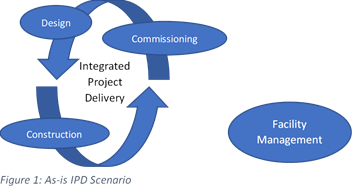 contractors, should be around the table drafting, developing their project deployment plan to streamline the design construction process. Unfortunately, facility managers are often the ones left out during the planning. Before occupancy, when the owners or facility managers acquire as-built models for the use of their operation and maintenance (O&M) routines, the delivered models contain all the details with perfect graphical representations but are missing the data required for facility management, i.e. warranty information, serial numbers; or have inconsistently populated data, like manufacturer, model numbers, etc. The reason is because during the delivery phase, designers, general contractors, and commissioned parties don’t fully comprehend what the facility manager needs. Meanwhile, there are no specific AM/FM data requirements or standards to regulate (QA/QC) for their data submission. In spite of early project integration efforts, without a standardized and accepted data dictionary that includes their asset data management needs, each stakeholder still works in their own silo, focuses on their own specifications, uses different contractual languages, and has different sets of parameters in their PIM. When the time for handoff comes at the end of construction, the scattered information becomes unmanageable and hard to be consolidated. Before a feasible AIM can be formed and inputted into a maintenance management solution, additional work and resources are required to untangle this inconsistent and ambiguous data, as well as gather all the missing information from the PIM.
Issues in Traditional Asset Management Data Dictionaries
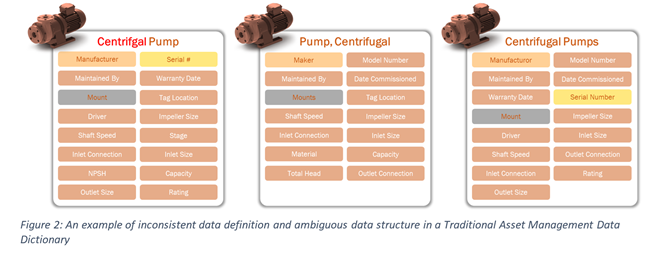
Besides the aforementioned gaps between PIM and AIM, there are several inherent issues and drawbacks within the traditional asset management realm. The first regards the asset management data dictionaries, which are typically either maintained or directly hosted on Computerized Maintenance Management Systems (CMMS), such as Maximo, SAP, or Archibus. For example, when setting up a Maximo environment, it is necessary to define a set of classifications and attributes – a form of a data dictionary. However, once the dictionary is defined in the CMMS, it remains in the system after implementation. New classifications and attributes can be added but the established structure cannot be easily altered or refined. In this inflexible data dictionary environment, the cumulative data update during the O&M period makes the inconsistent and ambiguous data structure unavoidable (as illustrated in Error! Reference source not found.). In order to prevent future ambiguity and inconsistent information in the CMMS, a complete asset data dictionary first need to be cleaned and refined prior to uploading to a CMMS. This leads to the second commonly observed issue in traditional asset management – scattered asset
 information.
Outside the CMMS platform without a designated central platform, asset information is usually maintained and tracked by different individuals from separate departments in various formats, including but not limited to BIM models, CAD files, excel spreadsheets, paper binders, text files, and PDFs. All these different formats and languages need to be gathered before reconciliation and consolidation for these diverse data sources and information can be established. Then it comes to the issue of reconciliation and consolidation of the data. Different departments have their individual means to track their information in various spreadsheets. There are also numerous systems that might be input in different periods by different individuals. While there is no immediate solution to query all the existing classifications and attributes among these scattered spreadsheets, the go-to method of those data collectors or managers is to come up with their own definition for their data and information at hand. As the example illustrated in Error! Reference source not found., three different asset definitions are defined by three different individuals at three different time periods. Although these pumps serve three different systems - hot water, chill water, and treatment water; they can be categorized and refined into one “Centrifugal Pump” without typo, and have a consistent attribute naming convention, i.e. Manufacturer, since “Manufacturer,” “Maker,” and “Manufacturor” are essentially the same attribute (as shown in Figure 3). This is just one small example within a haystack of asset information. 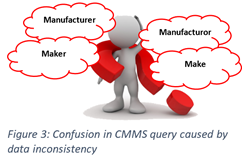 Furthermore, this dispersed and unsynchronized solution impedes teamwork and collaboration, limits data analytics support, and at the same time creates a lot of unnecessary rework, throughout the larger organization. Instead of capitalizing on the abundance of the available data for intelligent operation and maintenance, the facility or data managers drain their time trying to find the most updated spreadsheet.
A Solution that Bridge the Gaps – An FM-oriented DDMS
Illumed from the current issues and users’ needs, a more fundamental and practical approach might be a FM Data Dictionary Management System (DDMS), which can support different stakeholders and is accessible for various parties. A DDMS does not merely serves a dictionary or database. Its functionalities are specifically designed to address those commonly seen issues during PIM to AIM transition as well as during operation and maintenance.
A well-developed DDMS, at this era, should be designed as a web application focusing on an intelligent cloud-based solution to help reduce the effort required to manage asset data information while maximizing quality of data, as well as streamline data flow interoperability from delivery to the operational stage. It is a cloud-based, multi-tenant solution. Hence, there is zero infrastructure required to apply. It focuses on facility equipment and all the associated attributes that needed to be collected and included for all the different pieces of equipment. It enables users to migrate from traditionally scattered spreadsheets and fixed CMMS solutions that do not support the understanding of the data structure and performance to a fully functioning data management solution that provides a central and flexible platform for the entire enterprise. Furthermore, thanks to the current trend of Artificial Intelligence (A.I.), machine learning (ML) can be used behind the curtain to aggregate the wisdoms from all DDMS clients on the cloud to benefit each other. We will get into detail of that in the later part.
How does the DDMS Bridge the Gaps?
Compare to neighbor industry, say, manufacturing, the adoptions and utilizations of current trending technologies in our AECO industry are lagging behind. The bright side is there are a lot of mature technologies we can take great advantages of. A.I., ML, Cloud-based computation, and big data should be highlighted. Various of other algorithms and technologies should also be combined in the package to form the core functionalities that address the current issues among PIM to AIM transition and asset data management. Several key features of the DDMS will be discussed in the following content.
FM Data Dictionary Health Assessment
One of the main issues mentioned before is the ambiguous and inconsistent data structure and naming conventions. For all CMMS implementation, we want to start with a clean, consistent, and meaningful data dictionary, rather than fix all the troublesome in the future. Therefore, the DDMS should apply various algorithms to evaluate FM data dictionary health from different angles, including:
-
Semantical analysis (Fuzzy analysis)
-
Semantical ambiguous occurs everywhere in a data dictionary draft. Semantical issues are inevitable especially for some large-scale organization or agencies. Same asset or attribute can be named different in different systems or by different stakeholders (i.e., “hot water pump” vs “pump-hot water”, Figure 2 is a good example for this kind of issue). Fussy analysis is applied to identify non-exact matches of assets to spot the potential duplications of assets and or attribute naming. Different semantic patterns can be automatically recognized and applied corresponding fuzzy matching algorithms. Based on our past successful project experience, this analysis can greatly help clients to purify their data dictionary in a timely manner, especially for heavy excel users.
-
-
Grammar & Spelling Check
-
As the name implies, this function is designed to ensure correct spelling and meaningful input. For example, “Installation Data” should be “Installation Date.” While “Data” is a correctly spelled word, but it is the wrong word to use in the context of the example. Therefore, the DDMS will provide the suggestion to correct this type of error.
-
-
Completeness & Uniqueness Analysis
-
Completeness and uniqueness sometimes need to be highlighted based on clients’ requirements. For a most common example, acronym could be very important when users or asset managers use the aggregation of a series acronyms to form a unique code for each asset (i.e., CWS-GEN-CHILL). Missing one acronym will cause the incomplete of the asset code. Meanwhile, it will create confusion if two assets have the same acronym or one asset has two acronyms. Again, if utilizing excel spreadsheets to manage and develop data dictionary, these data glitches will be everywhere.
-
-
Classification Consistency Analysis
-
The classification and consistency check to ensure all the classification under different system and subsystems have the same set of attributes (again, Figure 2 is a very good example to show how a same classification can be developed differently).
-
 These health checks refine and consolidate the potential data duplications, as well as standardize the attributes and classifications. When all the asset information aggregated via Excel spreadsheets or other formats, the DDMS goes through all the asset information, including categories, systems, subsystems, assets, child assets, attributes, as well as all properties for attributes (domain, type, unit, etc.). All detected issues will be provided to the user in an interactive decision-making approach (as shown in Figure 4). This process provides a tremendous advantage for the data or facility manager who doesn’t have to go through every corner to purify the data dictionary.
Cloud Knowledge Community & Smart Recommendation
“Knowledge on the cloud” is the terms we are not only hearing more and more, but actually already melted in for a long while. From Wiki, Quora, Pinterest, to streaming media like YouTube and TikTok, users sharing their thoughts and knowledge and wisdom to form a community that can absorb every member’s contribution and in turns benefit each other. A single user’s thumb up or down will impact the piece of contents popularity among the entire knowledge tank. To all of us, this is not something new, to our industry, it is.
Every client and individual have different stories and approaches to manage their systems. This is a double-edge sword since it also means when developing their FM data dictionary, every client works in silo. The DDMS believes in “you don’t know what you don’t know” and tries to capture and aggregate all the knowledge and wisdom from multiple users/clients and analyze how clients/industries are building their data requirements.
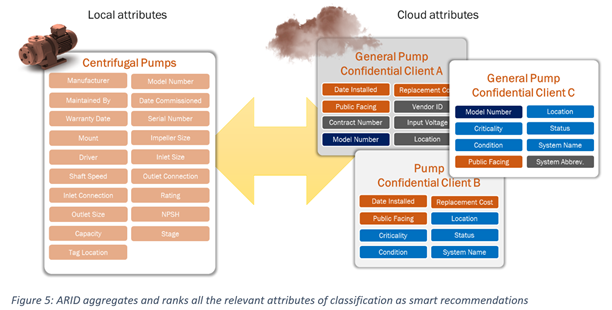
The DDMS applies cloud-based ML based on backend labeling to tagged asset classifications and attributes from different entities. Through the learning and training of the aggregated information and wisdom, the DDMS establishes a powerful knowledge base for smart recommendations of which attributes should be considered for a specific classification, as illustrated in Figure 5. When more users and clients involve and interact with the platform, it learns their preference and captures the importance of each attribute as it relates to its classification, similar to how the social media and web browsers learn the user’s preference and behavior. The ranking of each recommended attribute evolves accordingly, and the recommendations get aligned to the users’ needs.
Data Management throughout Project Lifecycle
The DDMS establishes data connections to multiple platforms (i.e. Excel, Revit, SAP, and Maximo) and acts as a central hub of all the data streams. This capability allows the DDMS to bridge the gaps in data management and benefit the entire building lifecycle. From the PIM to the AIM perspective, the DDMS serves as a synchronized platform that conveys all the owners / facility managers data requirements. As previously mentioned, one of the issues during the IPD process is that facility management’s requirements fail to be incorporated into the project delivery (see Figure 1). Here this FM-oriented DDMS could offer a nice remedy. The data dictionary of assets and attributes can be packaged into different Shared Parameter packages in PIM based on the project stage and discipline. Each stakeholder can incorporate the parameter groups that they are responsible for in their PIM and gather necessary information during the building design and construction process. In this fashion, each stakeholder won’t be overwhelmed by a full list of required inputs that are not relevant to them, and there is no ambiguous naming convention and missing information at the end of the project delivery (and we should not even care about if the clients follow COBie, or Uniformat). The DDMS also serves as the QA/QC during the handoff process. It can check the model information against the required data information and attributes, and provide a completion score and data analysis breakdown as the reference for the next round of the model submission. From the CMMS (e.g., Maximo, SAP) perspective, the data dictionaries hosted on the DDMS can be fully exported into a CMMS compatible format. For example, MxLoader for IBM Maximo. This capability of the DDMS saves an incredible amount of time for the CMMS implementor. By default, the implemented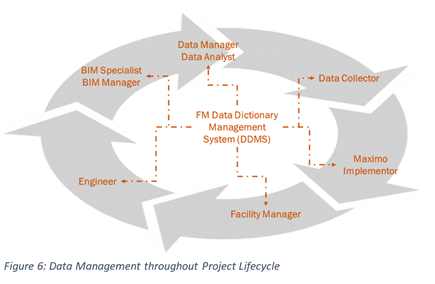 data dictionary would have been through the purification and standardization process in the DDMS already, which makes the implementation process even more smooth. Lastly, from the onsite data collection perspective, the DDMS facilitates the onsite data collection process by providing an easy to use interactive web application on a phone or tablet with the most updated information without them wasting time on fishing through the legacy spreadsheets. Figure 6 illustrates how DDMS could help streamline all project lifecycle from delivery to operational phase.
A Sample Application of the DDMS
Here presents a case study of one of our largest clients who use this FM-oriented DDMS to help them build up the Enterprise Level Asset Management Data Dictionary. This confidential client is a government agency in the US and has a variety portfolio of facilities and departments, most of which have their own database, platform, and classification means and language. As part of their EAM (Enterprise Asset Management) program, they wanted to migrate their data from the legacy systems into the EAM system. In order to integrate all of those systems into one, they have to develop a well-rounded data dictionary that can umbrella all facilities and departments. Their initial attempt was to develop systems via Excel spreadsheet. As a result, they ended up with numerous excel spreadsheets that can hardly be managed and synchronized. Therefore, they chose to utilize the a DDMS into their roadmap. They first applied the DDMS to consolidates all the data dictionaries across different facilities into a synchronized one. After the establishment of their unique single data dictionary, which is applicable for every facility within the organization, they were able to shift from historically siloed asset management practices to a more integrated and collaborative approach. By capitalizing on all the previously introduced functionalities that the DDMS provides, it helped the client reduce their overall program implementation substantially and saved extensively in agency costs. The DDMS will play an important role in conducting the data flow from delivery to operation phase for future project even after the data dictionary has been completed.
Summary
The development of the custom FM-oriented DDMS and its functionalities was originated from the needs of a solution to bridge the gaps between PIM and AIM and solve the issues during the asset management practices. Based on our clients’ experiences and feedback, the DDMS makes considerable improvements for our clients’ current practice in Asset Management. We can foresee it even can change and improve the entire BIM driven lifecycle. As illustrated in Error! Reference source not found., the first level - Project Development Level generally breakdown the building development phases, includes plan design, construction commissioning, and operation & maintenance. These phases might be slightly different depending on the contractual styles, i.e. Design-Bid-Build or Design-Build, but they could be very similar.
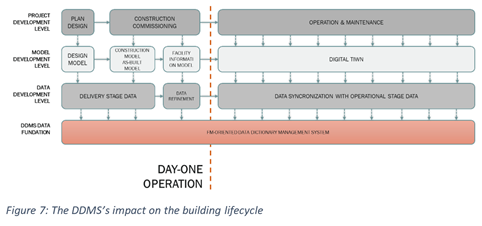 Underneath that is the Model Development Level that illustrates the different models used for different development phases, including design model, construction mode, as-built model, facility information model, and digital twin. A facility model is needed to gather the required information for asset management as issues mentioned above with regards to the as-built model. The facility model can then transform into operation maintenance digital twin. While digital twins are the current trend for operation and maintenance, but they require all the upstream information to be effective. The first two levels are often discussed during the BIM implementation lifecycle, but they are only the shell. The backbone of the process resides in the data flow – the Data Development Level and Data Foundation. There are design and construction data during the design delivery stage. These data need to be refined for the Facility Information Model for asset management use at the end of the construction. Throughout the operation and maintenance stage, refined, organized, and synchronized data are essential. Therefore, an FM-oriented DDMS with introduced functionalities can serve as the foundation to support all the data flow activities throughout the lifecycle, including collecting, refining, synchronizing, and managing. While ISO 19650 series is still underway and its potential benefits to the asset management and BIM implementation lifecycle are foreseeable, an FM-oriented DDMS would still be the essential foundation to support the data flow and activities throughout the building’s lifecycle.