
 By
By
A Data Management Framework for Sustainable Design and Facility Management
Eve S. Lin, Ph.D.,1 Xifan Chen, Ph.D.,2 and
George Broadbent3
1EAM Strategy Consultant, Microdesk Inc., 555 West 5th Street, 35th Floor, Office 35014, Los Angeles, CA 90013; e-mail: elin@microdesk.com
2EAM Assistant Director, Microdesk, Inc., 5 Penn Plaza, 14th Floor, New York, NY 10001; e-mail: jchen@microdesk.com
3Vice President of Asset Management, Microdesk, Inc., 5 Penn Plaza, 14th Floor, New York, NY 10001; e-mail: gbroadbent@microdesk.com
ABSTRACT
Building technologies’ advancement demonstrates the promising potential to utilize information and communication technologies (ICT) and the Internet of Things (IoT) for more efficient and effective building design, construction, and facility management. However, several accompanying issues arise regarding data quality, management, and utilization. Sustainable development introduces another layer of complexity in this data exponential growth era. Therefore, the research first identifies the main issues of current data use and management that hinder sustainable development through a literature review. Besides the commonly found issues of data quality, consistency, and interoperability issues, the lack of domain knowledge, data connection, standardized information requirements, and data correlations are the main impeding factors to support effective, sustainable design and operation. Consequently, the research proposes and demonstrates a Sustainable Development Data Management System (SDDMS) framework that can potentially bridge the gaps and serve as a solid foundation to support advanced data utilization and analysis.
INTRODUCTION
Sustainable building design and operation involve various stakeholders and require the consideration of multiple competing performance criteria. Moreover, each building element can have an impact on one or more sustainability indicators and building systems. Current green building codes and standards provide general top-down guidance and performance targets. However, a lack of bottom-up mapping depicts each building element’s relationship with different sustainable performance indicators. As a result, the design decisions are not derived from an integral perspective to understand trade-offs among sustainability goals.
Similarly, during the operations and maintenance stage, while the advancement of building automation systems, sensors, and IoT enables real-time building performance feedback, managing which assets respond to what kind of performance feedback is not clearly defined.
Aside from all the additional complexity introduced by sustainable development, there are inherent data management issues during the project lifecycle regarding data quality, inconsistency, ambiguity, and interoperability. To that end, this research proposes a data management framework that can potentially bridge the gaps and facilitate sustainable related data collection and utilization from the design to operational phase.
This research first conducts a literature review of the existing workflows adopted for sustainable design and facility management to identify the information needs and gaps to facilitate the current processes. Following the proposed framework description and how it can bridge the gaps, use case examples are presented to demonstrate the framework’s feasibility during design and management. The research results serve as the groundwork for the future advancement of the data management system for sustainability.
LITERATURE REVIEW & GAP ANALYSIS
Sustainable development is a complex problem that involves multiple interrelated components and systems throughout the building lifecycle, from concept formation to operation maintenance. Despite the complexity, sustainable development is an unavoidable path to ensure the development meets the present’s needs without compromising future generations’ ability to meet their own needs (Brundtland 1989). Various standards and international efforts, such as the United Nations, The U.S. Green Building Council (USGBC), and Building Research Establishment (BRE), have established various guidelines and certifications, i.e., Leadership in Energy and Environmental Design (LEED) and Building Research Establishment Environmental Assessment Method (BREEAM), to design and measure sustainable development. Major countries also set up international goals accompanied by local regulations to combat climate changes and reduce carbon emissions. In a data explosion era, the advancement of technologies and big data provides tremendous opportunities to help the Architecture, Engineering, Construction, and Owner (AECO) industry from the design phase through the operational stage. It also presents several challenges and barriers to information and data utilization to support the sustainable development process. Besides the commonly found issues of data quality, consistency, and interoperability issues during the project lifecycle, the literature review summarizes these challenges and barriers as follows:
Lack of domain knowledge. One of the major barriers to sustainable design and sustainable facility management is the lack of domain knowledge (Lin and Gerber 2014, Radebe and Ozumba 2020). During the design phase, to achieve specific sustainable design criteria, i.e., energy performance, a project typically relied on experienced designers or sustainability consultants to conduct design performance analysis. However, due to the lack of domain knowledge and tool interoperability issues, the sustainability analysis is often performed at the end of the design stage as an evaluation tool instead of assisting design decision-making during the design process (Lin and Gerber 2014, Jalaei et al. 2020). Therefore, the significant components and elements have been decided, and their sustainability-related attributes are not considered during the early design stage, where the decisions made can affect up to 80% of the building’s environmental impacts and operational costs (Bogenstätter 2000). According to Radebe and Ozumba (2020), among major barriers of lack of knowledge, senior management commitment, time and financial constraints, and lack of capability, lack of knowledge is the most significant barrier to sustainable facility management implementation. Typically, facility managers do not need to have sustainable operations as part of their required domain knowledge. Moreover, there is a severe scarcity of sustainability-related information to support sustainable facility management activities.
Data disconnection. Due to the tool interoperability, diverse domain expertise, different lifecycle activities, sustainability-related data scatter all over the place without a central repository management platform (Lin and Gerber 2014). While the data disconnection issue impacts every stage of the building lifecycle, it is one of the main impeding factors for sustainable development. The data disconnections can be observed during various data exchange activities, including but not limited to data exchange from design model to performance analysis, from design model to construction model, and from construction model to facility management model. The data disconnection between the design and analysis platforms creates a discrepancy between the analyzed data and the actual documented design (Lin and Gerber 2014). The data disconnection between the design and construction models compromises the as-built information from the original design intent (Lin et al. 2020). The data disconnection between as-built and facility management FM models costs extra time and effort for data collection and loses several important sustainability-related attributes to support facility management activities.
Lack of information exchange standards & requirements. The amount of data and information involved in the AECO industry is growing exponentially along with the data explosion and digital transformation era wave. Applications of information and communication technologies (ICT) and the Internet of Things (IoT) in building design and management introduce another layer of the data stack. In the ideal scenario, these increasing data and information present several opportunities for cost and time reduction, promote human comfort, increase space usage, decrease energy consumption, and increase indoor environmental quality. However, due to the lack of data information exchange standards and requirements, these data sources cannot be effectively managed and leveraged, and further induce inefficient decisions and processes. (Terreno et al. 2019, Lin et al. 2020) Some examples of data-related issues include but are not limited to inconsistent naming, formatting, and data storage, ambiguous and invalidated data sources, insufficient or irrelevant information. Several coding standards and data exchange formats, i.e., OmniClass, UniFormat, and COBie, were developed to address this issue (Chen et al. 2020). The international standard development, the ISO19650 series, also intends to standardize information management over the whole building lifecycle. However, none of the existing standards touched on sustainability-related attributes and requirements to streamline the data transition from the design to the operational stage.
Lack of data mapping & synergy. During sustainable design phases, the design team utilizes performance analysis tools to evaluate the design performance to ensure the design can meet the defined sustainable development goals, i.e., energy performance, lighting performance, and human comfort. The actual building performance relies on performance monitoring and metering to understand whether the building performs as intended through the operational phase. Coupling IoT and sensor technologies with Building Management Systems (BMS), Building Automation Systems (BAS), and Computerized Maintenance Management Systems (CMMS) are widely adopted as favorable facility management tools. The further integration with Artificial Intelligence (AI) and Machine Learning (ML) enabled learning, and automated systems provide preventive maintenance, fault detection and diagnostics, and various advanced capabilities to support facility management. While these solutions seem promising, several issues were found during current practical applications throughout the project lifecycle, especially during sustainable development. Some issues were aggregated from the previously stated data disconnection and the lack of data exchange standards and requirements. Another contributing factor is the lack of data mapping and synergy between building elements, performance indicators, and building automation systems.
An immense amount of data can be collected by various sensors and IoT. However, without mapping the collected data to meaningful performance indicators or predefined operation strategies, those data provide insufficient information to support facility management (Demirdöğen et al. 2020) effectively. For instance, what does it mean when a carbon monoxide sensor reads a value of 10 ppm? Does it mean the air quality is bad? What are the predefined operation strategies? What are the related building assets that correlate with this reading? Is it good or bad in terms of visual comfort when a light level sensor reads 400 lux? The answer depends on the space usage and the standard of choice. Based on ISO 899501:2002, 400 lux will be too much for a bedroom but insufficient for a laboratory.
Similarly, for energy consumption, what does it mean when an electrical meter reads 4000 W/hour? These readings provide no value if missing the associated contexts, i.e., space usage, performance thresholds, and related building assets, which can often be obtained during the building design stage. Moreover, one asset might correlate with different performance indicators. For example, increasing the outdoor air rate will improve indoor air quality but use more energy. This information is critical to consider when choosing operational strategies and is often missing in the current FM systems.
PROPOSED DATA MANAGEMENT FRAMEWORK
Deduced from the literature review presented issues, the research proposes a conceptual framework for a Sustainable Development Data Management System (SDDMS) to bridge the gaps and enable a smoother utilization of technologies. The framework is built on top of an existing Data Dictionary Management System (DDMS) (Lin et al. 2020) and adds sustainability-related data requirements to facilitate sustainable development throughout the project lifecycle. The existing DDMS is an intelligent cloud-based solution developed to bridge the gaps between the project information model (PIM) and the asset information model (AIM) during the asset management stage. It adopts various AI- and ML-enabled algorithms to evaluate data health from different aspects, such as semantical analysis (fuzzy analysis), grammar and spell check, completeness and uniqueness analysis, and classification consistency analysis. In addition, the DDMS applies cloud-based ML based on backend labeling to tagged asset classifications and attributes from different entities to establish a robust knowledge base for intelligent recommendations (Lin et al. 2020). The implementations of the DDMS have proven to be a fundamental and practical approach as a data management tool to support different stakeholders and varying activities beyond the operational phase as a central data management vessel throughout the project lifecycle (Lin et al. 2020). However, the existing DDMS has not fully addressed the need specific for sustainable development. Therefore, the proposed SDDMS focuses on each building element’s sustainability-related data requirements to extend the DDMS’s use to support sustainable design and operation. The SDDMS’s data requirements for each building element include (1) sustainability-related attributes, (2) location properties, and (3) correlations and synergy information.
Sustainability-related attributes. Based on a project’s performance development goals, several performance properties are tracked and designed accordingly during the early design stage, such as a window’s thermal transmittance, thermal resistance, solar heat gain coefficient (SHGC), embodied carbon, recycle content, etc. However, these informative values are typically lost during the operational stage and are not integrated with the performance tracking platform. These attributes can be crucial information to support sustainable design, operation, and renovation strategies and bridge the gap of lacking domain knowledge. For example, designers will have sustainability-related attributes in mind without sustainability consultants’ or engineers’ support when specifying windows and wall assemblies. The sustainability-related attributes can also provide decision support for facility managers to determine how to improve an office’s energy efficiency: improving lighting fixtures’ efficiency to decrease lighting power density, lowering SHGC to reduce cooling load, or decreasing temperature set point to decrease the heating load.
Location properties. Location properties include (1) location’s geo-spatial information (i.e., site, building, floor, room, area, and volume); (2) space usage; and (3) occupancy information (i.e., occupancy type and density). This information is crucial to establish the correlation between the element and its location context for determining the performance thresholds for each building element. For example, a window with higher SHGC is acceptable in a storage room but not acceptable in an office area since a storage area has broader temperature tolerance than the office area. The space properties are the essential key to link building elements to their correlated performance criteria.
Correlations and synergy information. In the SDDMS, each element and its sustainability-related attributes should include the correlation information as following:
-
Associated sustainable key performance indicators (KPIs): each element and its attributes might correlate to one or more KPIs and might positively or negatively impact different KPIs. For example, a window’s SHGC impacts both energy performance and visual comfort. The decrease of SHGC might positively impact cooling load but negatively impact heating load. Therefore, mapping every element and its attributes to their associated KPIs can provide a holistic perspective and trade-off studies to identify the optimized strategies during the design and operational stages. Therefore, KPI associations can bridge disconnected data and the lack of data mapping and synergy.
-
Data collection project phase and responsible stakeholder: For the SDDMS to be the central repository throughout the project lifecycle and bridge the gap of lacking information exchange standards and requirements, it is necessary to specify the project phase and responsible stakeholder of each building element and its attributes to prevent the data lost during each data exchange stage. Clearly defined data collection phase and ownership can also ensure the data are diligently collected and recorded with its corresponding purpose in the SDDMS without duplication and inconsistency. The SDDMS becomes the project team’s knowledge base and, therefore, overcomes the lack of domain knowledge and disconnected data.
-
Supported project activities: This is where the correlation activities that the data support are specified. For instance, thermal transmittance and resistance information can support the energy performance analysis and impact thermal comfort; embodied carbon, recycle content, and material content are related to lifecycle assessments and responsible sourcing. With this information, SDDMS provides knowledge references to support activities during the project lifecycle and establishes the correlation to the sustainable KPIs. During the design stage, energy simulation data can, later on, support the energy performance monitoring and management during the operational phase. This information can bridge the gap between data disconnection and the lack of domain knowledge.
-
Associated green building standards: this information establishes the data foundation for sustainable performance evaluation against the green standards of interests and promotes using green standards as a sustainable development reference instead of a tool merely for recognition. Each sustainable KPI of a project might correlate with different green building standards. For instance, the project’s indoor air quality criteria can fulfill credits for LEED, BREEAM, WELL, and the UN’s Sustainable Development Goals (SDGs). The associated green building standard information can provide an overview of a project’s KPI fulfillment level to other major green building standards, facilitate the project to meet a specific green building standard, or establish the performance threshold as the benchmark for operational monitoring, as well as illustrate the synergy to other reference green standards. The information bridges the gap between lack of data mapping and synergy.
-
Associated BAS and BMS: The final step is to establish the correlation between each element’s attributes and the BAS and BMS. This information is essential to set up the control mechanism and logic of the BAS and BMS. It also provides the correlation mapping between sustainable KPIs and different controls of BAS and BMS. Similar to the element’s correlation with KPIs, each element impacts and correlates with one or more control aspects of the BAS and BMS. For instance, a lighting fixture operation is controlled by the lighting control system, but it also impacts a space’s energy performance. To holistically control a building requires thorough considerations of each variation’s influence and trade-offs on other KPIs. One value change might impact the performance of the other. Therefore, data’s association to BAS and BMS in the SDDMS serves as the foundation for the advanced automatic control mechanism. It also bridges the gaps of the lack of domain knowledge, data connection, data mapping, and synergy.

Figure 1. Illustration of the proposed SDDMS.
EXAMPLES OF USE CASES
This paper presents two use cases of SDDMS for setting up an office space’s monitoring dashboard with two sustainable KPIs, energy use intensity (EUI) and carbon monoxide (CO) concentration, as illustrated in Figure 2.
Typically, the energy meter readings are the cumulated energy consumption of a specific space area through a set period. A monitoring system can continuously collect the data, save them as data historians, and plot the result on a real-time dashboard. However, the collected data, without comparing to a set threshold to trigger either the facility managers’ action or automatic responses, is of no use to facilitate the building’s operation and maintenance. Both the energy meter’s reading and its metering space area are required to provide a comparable value as EUI to establish a proper performance threshold, as illustrated in Figure 2. SDDMS can then provide a range of energy performance thresholds considering the space properties and its correlated green standards. Using EnergyStar as the benchmark standard, the EUI threshold of an office is 52.9 kBtu/sqft. This value can then be used to set the alert in CMMS to inform the facility manager or set up automatic responses accordingly. The CMMS or facility managers’ can then refer back to the SDDMS to isolate a list of the building elements and attributes that impact the EUI value and further utilize the list to configure operation and maintenance strategies.
Similarly, for the use case of air quality monitoring, CO concentration is the KPI. CO sensor reads 10 ppm and feeds the information to the performance dashboard. SDDMS can then provide a performance threshold considering the space properties and correlated green standards. Since it is an office space, a healthy indoor CO concentration should maintain within 9 ppm per WELL Building Standard. Therefore, the value can be used to set the alarm to inform the air quality condition and trigger corresponding actions accordingly.
The example space is a single-occupancy type space. More advanced weighted calculation and scoring systems need to be implemented in a multi-occupancy type scenario to properly determine the performance thresholds and scores. Nevertheless, both use cases demonstrate how SDDMS can bridge the data disconnection, leverage domain knowledge, and provide the foundation to support decision-making for more effective operation and maintenance.
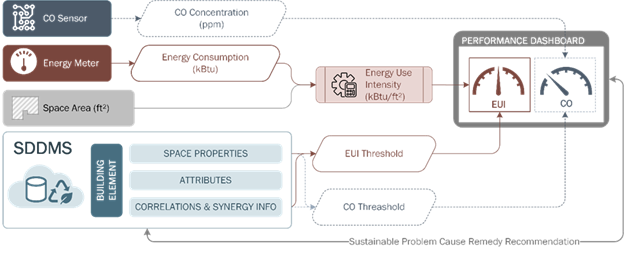
Figure 2. A use case illustration of the SDDMS for energy and air quality monitoring.
CONCLUSION
The research proposes a conceptual framework of a SDDMS that can potentially bridge the gaps of lack of domain knowledge, data connection, information exchange requirements, and data mapping and synergy. Built on top of an existing DDMS, the SDDMS can leverage advanced AI and ML technologies to ensure data quality, consistency, bypass the tools’ limitations and restrictions, and serve as a central data repository throughout the project lifecycle, as well as streamline data flow interoperability from delivery to the operational stage. Adding on the required data specifications of sustainability-related attributes, the proposed SDDMS can be the fundamental data framework to facilitate further sustainable development. While several essential information and data specifications mentioned in the framework are not new, in current practice, these data requirements are utilized and applied sporadically in the different green building standards, building data exchange standards, and BIM implementation framework. This research provides a conceptual integration approach with a feasible and practical plate platform. More complication is foreseeable when the system gets more intricate, but the framework can be the foundation for advanced analytics, human augmented AI, and analytics strategy. While ISO 19650 series is still underway and presents potential benefits to the project lifecycle’s data management, an SDDMS would still be the essential foundation for supporting the data flow and activities throughout the building lifecycle, especially for sustainable development.
REFERENCES
Bogenstätter, U. 2000. "Prediction and optimization of life-cycle costs in early design." Building Research & Information, 28 (5-6), 376-386.
Brundtland, G. H. 1989. "Global Change and Our Common Future." Environment: Science and Policy for Sustainable Development, 31 (5), 16-43.
Chen, X. J., E. Lin, and G. Broadbent. 2020. "New Era of BIM Lifecycle Implementation - Part 2: Reviewing the Adoption of Existing Standards from PIM to AIM." Civil + Structural Engineer, 6 (9), 40-43.
Demirdöğen, G., Z. Işık, and Y. Arayici. 2020. "Lean Management Framework for Healthcare Facilities Integrating BIM, BEPS and Big Data Analytics." Sustainability, 12 (17), 7061.
Jalaei, F., F. Jalaei, and S. Mohammadi. 2020. "An integrated BIM-LEED application to automate sustainable design assessment framework at the conceptual stage of building projects." Sustainable Cities and Society, 53, 101979.
Lin, E., X. J. Chen, and G. Broadbent. 2020. "New Era of BIM Lifecycle Implementation - Part 3: Implementation of An FM-oriented Data Dictionary Management System (DDMS) for Lifecycle Project Delivery." Civil + Structural Engineer, 6 (10), 10-14.
Lin, S.-H., and D. J. Gerber. 2014. "Evolutionary Energy Performance Feedback for Design: Multidisciplinary Design Optimization and Performance Boundaries for Design Decision Support." Energy and Buildings, 84, 426-441.
Radebe, S., and A. O. U. Ozumba. 2020. "Challenges of implementing sustainable facilities management in higher institutions of learning."In Proc., The ASOCSA 14th Built Environment Conference, Durban, South Africa, IOP Publishing Ltd.
Terreno, S., S. Asadi, and C. Anumba. 2019. "An Exploration of Synergies between Lean Concepts and BIM in FM: A Review and Directions for Future Research." Buildings, 9 (6), 147.